
The mechanism layer for sovereign genomics
The medicine may already exist. Nobody has looked.
There are around 7,000 known rare diseases, and roughly 19 in 20 have no approved treatment, because the economics of developing one never close. About 2,500 approved medicines are already safe and already manufactured. Biofacta searches the space between the two, in human and animal medicine alike.
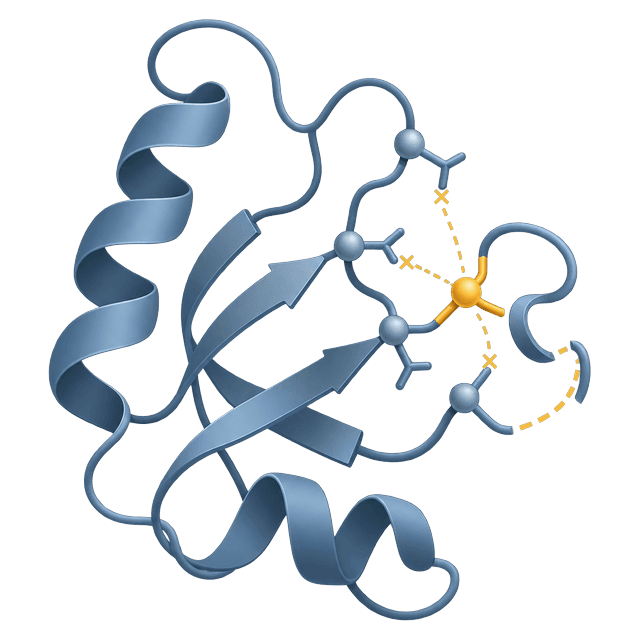
Imatinib arriving in the site it occupies on the ABL kinase domain.
PDB 2HYY. Where it binds and what it touches are measured. The way in is drawn.
- ~7,000
- known rare diseases
- ~95%
- with no approved treatment
- ~2,500
- approved molecules on the shelf
Rare-disease counts are the commonly cited public figures. The molecule count is the approved small molecules carrying a usable chemical structure, from open drug-database releases. Sources are set out on the thesis page.
Three ways in
A genetic variant goes in. A shortlist of medicines comes out.
A team brings a gene and the variant found in it, in the notation its report already uses. Back comes the handful of approved medicines worth laboratory time against that protein, each having answered three questions, cheapest first.
- 01
What the variant breaks
A protein's shape is what lets it do its job. We work out what one small change does to that shape, and which of the protein's connections it disturbs. That is the part that says where to aim.
- 02
Which medicines still fit
Against that protein we search the medicines regulators have already cleared, deliberately including the generics no developer has a commercial reason to revisit.
- 03
What can actually be obtained
Each candidate arrives with the record every approved medicine carries, and with whether it is registered, sold and stocked where the team works.
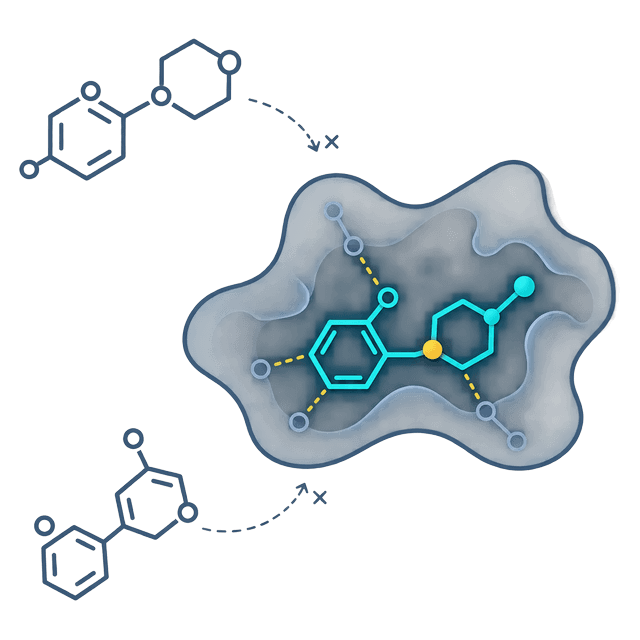

A candidate on the shelf is not a hypothesis waiting on a supply chain.
Three kinds of evidence, kept three kinds apart
A model estimate, a line on a regulatory label and a pharmacy's stock list are three different sorts of claim. Blending them into one score would hide the thing a reviewer needs to see, so the caveat travels with the number instead.
Glibenclamide
Approved · off-patent · oral
- Model estimate
- Interaction disruptedPredicted, not measured
- Regulatory record
- Documented target of this classRetrieved as fact, with its date
- Availability
- Registered and stocked locallyFrom the institution's own formulary
Set aside at this step: 2,491 molecules. Each with a reason recorded.
This is a mechanism and a hypothesis for laboratory triage. It is not a treatment recommendation, and nothing here predicts whether a patient would benefit.
The refusals are the product
A tool that answers every question is one you cannot trust with any of them. Biofacta is built to stop, and where the evidence cannot carry a conclusion it says so at the point you look for it.
- It will not rank medicines against a target
- The model's score barely moves when the molecule changes and moves sharply when the protein does, so any ordering would describe our catalogue rather than your gene. Which molecules are documented as acting on a protein is retrieved as fact, with its date, never generated.
- It will not blend evidence into one number
- There is no overall score, because an overall score is the one number a reviewer cannot check and a vendor can quietly tune.
- It will not predict tolerance or benefit
- There is no pharmacokinetics here and no adverse-event model. Safety comes from the empirical record: labels, contraindications and years of reports from real use. Binding is not efficacy, and nothing here claims otherwise.
- It will stop before it reaches you
- Before any result, the tool checks that it recovers biology already known for your protein, and that common harmless variants in your gene score as harmless. If either check fails, the run halts and reports the failure.
Every result records its inputs and its evidence, so a finding can be reproduced months later exactly as first seen. That is what makes it publishable.
One technology, two kinds of medicine
The biology reasoned over here is not unique to people, so the same approach applies directly to companion and production animals: the same neglected diseases, a fraction of the competition, and a shorter path from evidence to practice.
Human medicine
Conditions with real patient need and no viable commercial development route, including rare and inherited disease.
Animal health
Companion and production animal medicine, where unmet need is widespread and new medicines are rarer still.
Bring us a variant
Biofacta is built for hospital genomics teams, national genomics programmes and veterinary developers. If you have a protein you already care about and a variant you cannot explain, that is the conversation we want.
Biofacta is pre-launch. The walkthrough marks what runs today, step by step.Read the walkthrough