
How it works
From an altered instruction to a medicine that already exists
Genes, proteins, and the things that bind them
Three ideas carry almost the whole of it: what a gene does, what a protein does, and what a medicine does to a protein.
01
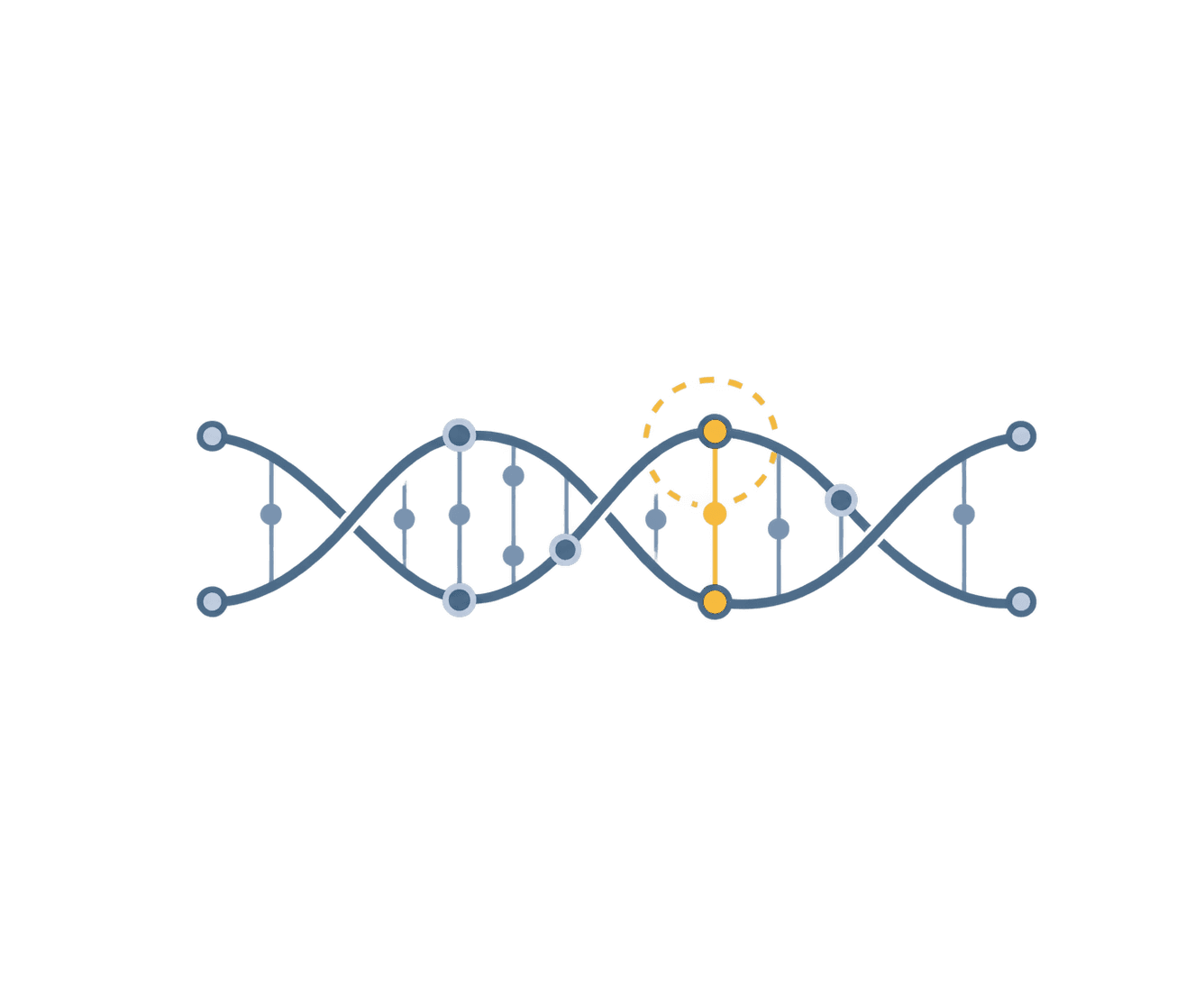
A gene is an instruction
Genes tell the body how to build proteins. When a gene carries a variant, a difference in its sequence, the instruction it gives is altered, and so is whatever gets built from it.
02
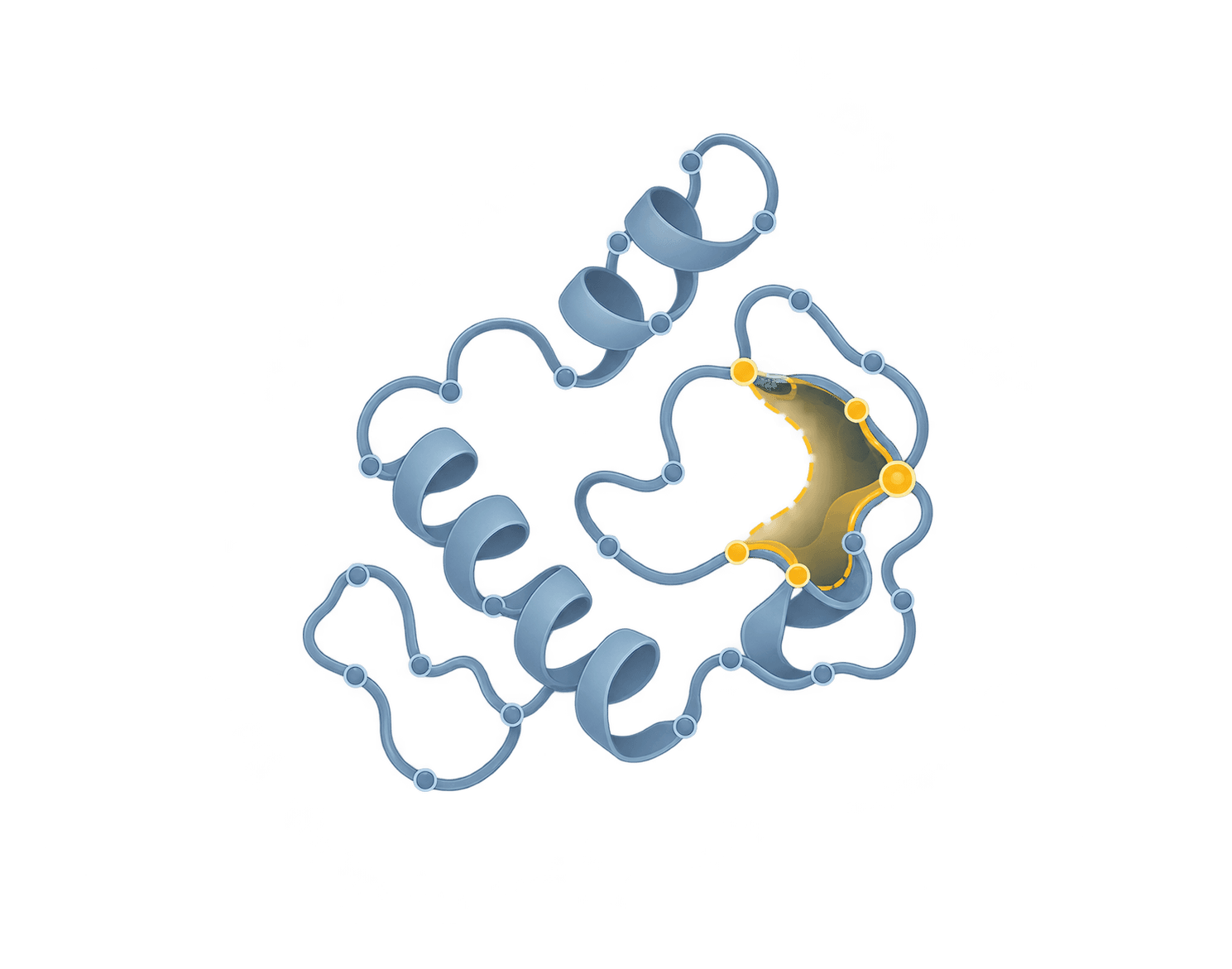
Proteins do the work
Proteins are what actually run a living body. They carry signals, break things down, and switch processes on and off. A protein built from an altered instruction behaves differently, and the disease is what that difference looks like from the outside.
03
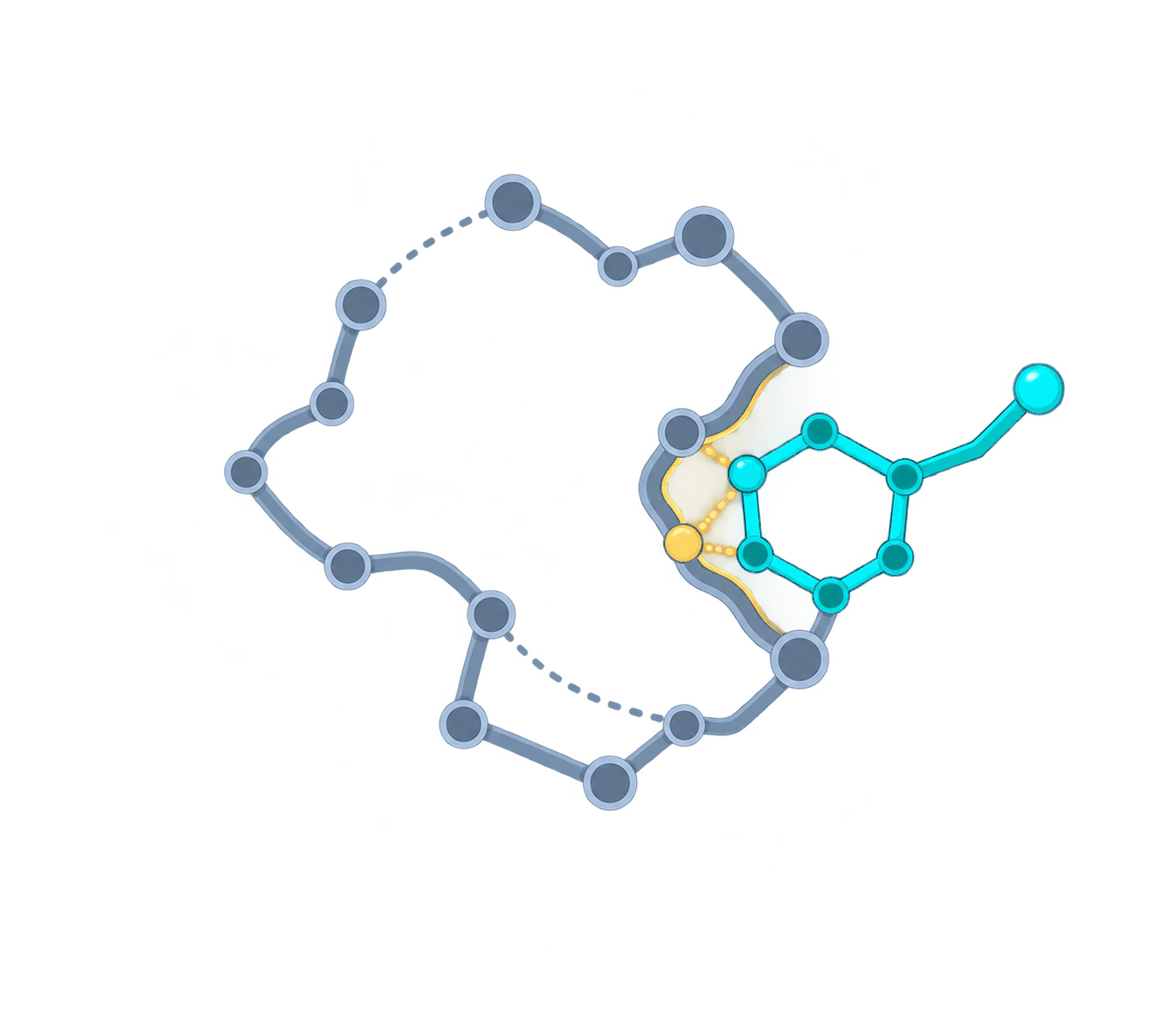
Medicines act on proteins
Almost every medicine works by attaching to a protein and changing what it does. So the vague question, how do we treat this disease, becomes a precise one: which molecule attaches to this protein, and does the right thing once it gets there.
Illustrations, not structural renderings. Real proteins fold in three dimensions and are far larger than anything shown here.
A laboratory can test a handful. The question is which.
There are thousands of approved molecules, and a research team can properly test perhaps five or ten pairings in a project. Each one is weeks of a scientist's time and materials that could have gone somewhere else. So the decision that matters is not how to search everything. It is which few to spend laboratory time on, and how to defend that choice afterwards to a funder, a review committee, or a colleague who would have picked differently.
Today that choice comes from reading the literature, from experience, and from what a collaborator suggests. That is how most good science gets done. What it cannot easily do is weigh mechanism across thousands of candidates at once, or set down in writing why the others were put aside.
The choice of what to test stops being a judgement defended from memory and becomes one that can be shown.
Seven steps, cheapest checks first
Each step discards candidates the next does not have to consider, and the order matters as much as the steps themselves. The cheap checks run first, so laboratory time is spent only on what survives all of them.
- 01
It starts with a variant
A team brings a gene and the specific variant found in it, in the notation a genetics report already uses. The identifier is checked against known biology before anything runs, so everything downstream concerns the gene that was actually named.
- 02
From gene to protein
That variant alters the protein the gene builds, sometimes by a single building block out of hundreds. A protein's shape is what lets it do its job, so the question becomes what a change that small does to that shape.
- 03
What the variant does to the protein
A protein's behaviour follows its shape: how it folds, how stable it stays once folded, and what it can still hold on to. Working out how a specific variant disturbs that is what turns a gene into something worth aiming a medicine at.
- 04
Which approved molecules engage that protein
Against that protein we search a curated collection of medicines regulators have already cleared, deliberately including the generics no developer has a commercial reason to revisit. Each pairing carries the strength of the evidence behind it, so a firm lead is distinguishable from a marginal one.
- 05
Safety, and where the molecule actually goes
Molecules are screened for signs of toxicity, and for whether they reach the tissue that matters: one that does not cross into the brain is of little use against a neurological condition, however well it binds. Alongside that sits the documented record every approved medicine carries, in its official labelling and in years of reports from real use.
- 06
Whether it can actually be obtained
A promising molecule is only useful if the team can get hold of it. We track where a molecule is registered, whether it is genuinely marketed there and at what price, so a result is judged for feasibility where the team actually works rather than in the abstract. No model can supply this.
- 07
Everything can be replayed
Every result records its inputs, the evidence behind it and the moment it was produced, so a finding can be reproduced months later exactly as it was first seen.
Biofacta is pre-launch. The walkthrough marks what runs today, step by step.Read the walkthrough
Five blind spots in the tools researchers use today
The individual pieces of this are not new. What the assembled system makes possible is a set of questions existing tools cannot reach, because each one needs several steps joined together.
- What does this variant actually break?
- Existing tools return a single score per variant, which is a property of the protein. It cannot say which of that protein's connections has been lost, and that is the part that tells a team where to aim.
- Does a documented medicine still fit this patient's version of the protein?
- Drug databases do not account for a patient's variant. A few hundred well known cases are curated by hand in cancer. Little of it is predicted, and almost none of it generalises.
- Do several of this patient's variants break the same piece of machinery?
- Proteins rarely work alone. A single job in the body usually needs a whole group of them clipped together. Several variants can each look harmless on their own while together disabling one shared group. Existing tools score variants one at a time, so that pattern is invisible to them.
- What could we try that we can actually obtain, here?
- Mechanism and availability live in separate systems. Global efforts score medicines against diseases for the world; the lists of what a hospital stocks are administrative databases with no biology attached. Nothing joins them.
- Which of our unexplained cases deserve a second look?
- Existing tools answer one query at a time, which is the wrong unit of work for a backlog of thousands.
Four things that compound
Each one makes the next harder for anyone else to assemble, which is why the four together are a stronger position than any of them alone.
We start only from approved molecules
Safety is already established, manufacturing already exists, and the molecule is often already generic. That removes the slowest and most expensive decade of the usual path.
We work where few others do
Our focus is the conditions with no commercial development route, rather than competing for the crowded targets everyone is already funding.
The same technology serves animals
Human and veterinary medicine run on the same underlying biology, so one approach addresses two markets with very different levels of competition.
It can run entirely inside the institution
On our infrastructure, or on a pre-configured machine installed on the institution's own network, hardware included, behind its own perimeter.
The computing already done stays done, so every protein assessed makes the next answer cheaper to reach. Access to regional availability data is negotiated rather than scraped, which is slow to win and slow to copy. The advantage is not any one component. It is that they accumulate.